The Information Game in Democracy by Dipankar Sinha
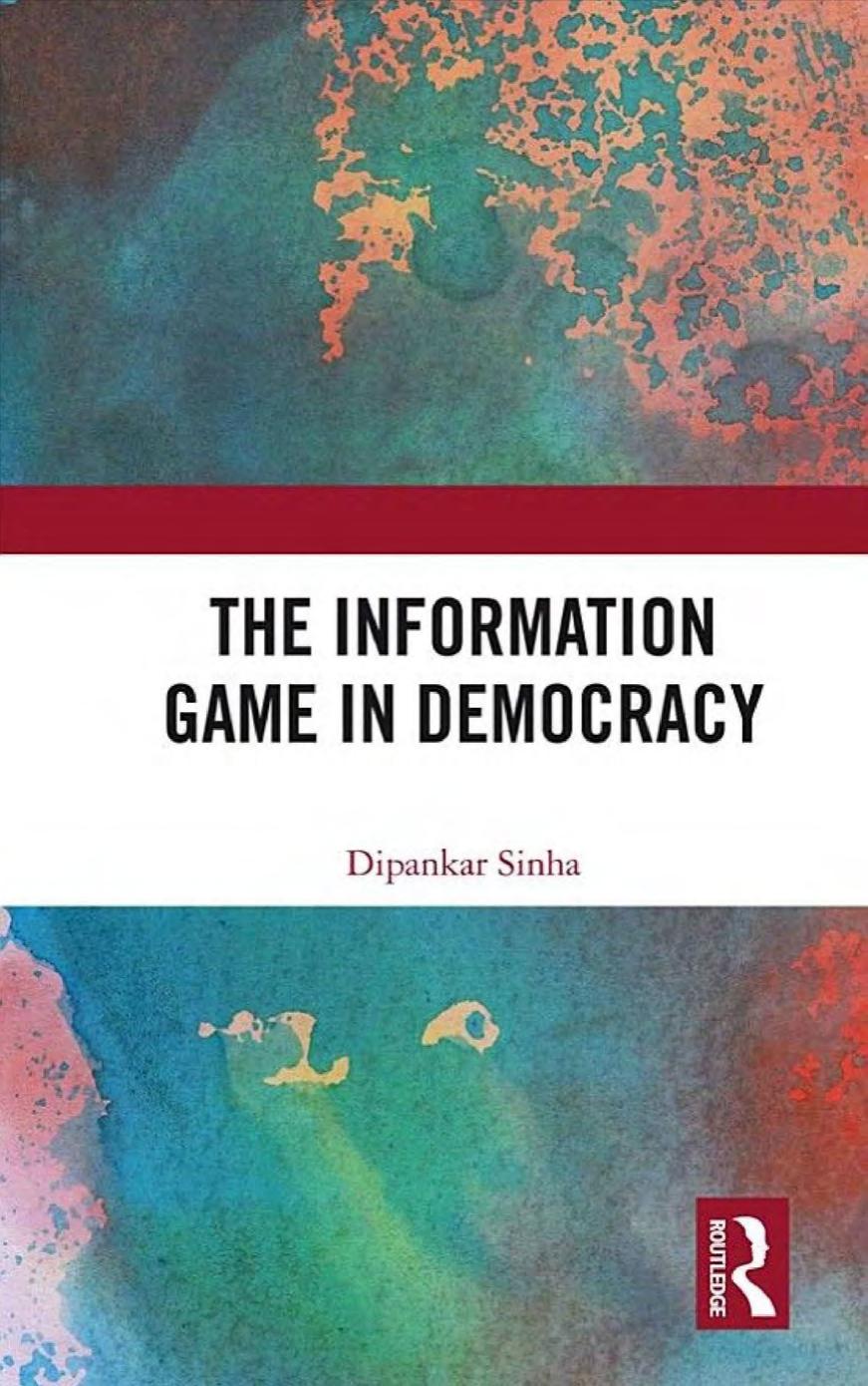
Author:Dipankar Sinha
Language: eng
Format: epub, pdf
Publisher: Routledge
Published: 2018-02-07T16:00:00+00:00
The act of democratisation in cool capitalism is lent a sharper edge by Dick Pountain. In tracing the role of cool capitalism in social and cultural reconfiguring he notes that it originally justified itself by promising unlimited freedom to satisfy individual whim, and employing seduction rather than coercion to legitimise the continuing unequal relations of production. This it does among other things by geographical separation of production from consumption. Such freedom, he adds, ‘was never more than illusory though’. In its other act, Pountain argues, cool capitalism also aspires to revolutionise everyday lives, but in pastiche only, by de-skilling the arts so that everyone can participate and become a ‘creative’. He provides (Pountain 2013) the example of Andy Warhol’s dismissal of painterly skill – the synthesiser/sequencer – rapping to replace singing – acting by attitude rather than technique – all of these permit stardom to be acquired democratically without the lifetime study formerly required. Pountain writes (2013) that cool capitalism ‘prefers where possible to distribute self-esteem rather than capital (though plenty of that continues to be accumulated, by ever fewer) and this kind of democratic/populist/ ‘anti-elitist’ rhetoric is sufficiently powerful to feed people’s aspirations toward wealth, despite all visible evidence of dwindling real living standards’.
Effectiveness is all the more enhanced if being ‘cool’ is combined with being ‘soft’ in terms of approaching power. The ‘coolness’ of capitalism as-it-exists-now cannot be detached from the restyling of the concept and practice of power. Cool capitalism, so to say, is a state which is both a cause and consequence of ‘soft power’ resources. Joseph S. Nye, Jr. (2004) makes the distinction between ‘hard’ and ‘soft’ power and states that such a distinction might be one of degree and both may have the commonality in seeking to achieve ends by controlling the behavior of others (p. 66). Nye’s specific context has been the role of the USA in the international arena but what he points out is also the tagline of capitalism’s new realisation that the proof of power does not lie in the quantum of resources being held but in the ability to change the behavior of others (p. 69). But as is evident from Nye’s contentions while the ‘hard’ power rests largely on command behaviour and coercion its ‘soft’ counterpart relies mainly on the cooptive behaviour marked by generating attractiveness of culture and ideology. In Nye’s scheme there is a continuum of power relations in which the movement is from the ‘hard’ to the ‘soft’. The agenda setting function of ‘soft’ power is no less effective than the ‘hard’ power in strategic advantages, in minimising resistance and in ensuring willingness to conform. Nye is convinced that in the Information Age power in general is ‘becoming less transferable, less coercive, and less tangible’ (p. 77). While capitalism does not find any mention by Nye what he finds in the politics of information is worth mentioning. He argues that one of the most interesting aspects of power in relation to increasing flows of information is the ‘paradox of plenty’.
Download
The Information Game in Democracy by Dipankar Sinha.pdf
This site does not store any files on its server. We only index and link to content provided by other sites. Please contact the content providers to delete copyright contents if any and email us, we'll remove relevant links or contents immediately.
| Anthropology | Archaeology |
| Philosophy | Politics & Government |
| Social Sciences | Sociology |
| Women's Studies |
The Secret History by Donna Tartt(19476)
The Social Justice Warrior Handbook by Lisa De Pasquale(12297)
Thirteen Reasons Why by Jay Asher(9127)
This Is How You Lose Her by Junot Diaz(7059)
Weapons of Math Destruction by Cathy O'Neil(6471)
Zero to One by Peter Thiel(5953)
Beartown by Fredrik Backman(5947)
The Myth of the Strong Leader by Archie Brown(5631)
The Fire Next Time by James Baldwin(5592)
How Democracies Die by Steven Levitsky & Daniel Ziblatt(5333)
Promise Me, Dad by Joe Biden(5230)
Stone's Rules by Roger Stone(5196)
A Higher Loyalty: Truth, Lies, and Leadership by James Comey(5091)
100 Deadly Skills by Clint Emerson(5028)
Rise and Kill First by Ronen Bergman(4906)
Secrecy World by Jake Bernstein(4890)
The David Icke Guide to the Global Conspiracy (and how to end it) by David Icke(4854)
The Doomsday Machine by Daniel Ellsberg(4627)
The Farm by Tom Rob Smith(4614)
